Monday, April 23, 2018

Reading Aloud to Young Children Has Benefits for Behavior and Attention

This article was originally published for the New York Times.

CreditiStock

Friday, April 20, 2018

Wednesday, April 4, 2018

Boundaries, Routines and Early Bedtimes: 13 Habits That Raise Well-Adjusted Kids


This is from a post by Lauren Tamm and can be found here: https://themilitarywifeandmom.com/raise-well-adjusted-kid/
I keep seeing posts about “entitled kids” making the rounds lately. In fact, you don’t have to look hard before you see things written about how “lazy” and “narcissistic” and “downright terrible” kids are these days.
As a parent of younger kids, you read these articles and feel paralyzed by overwhelm and fear and mixed messages. What exactly is the right thing to do? Where am I going wrong? Should I give up and start a savings account for my kids’ future therapy sessions?
The part that scares me the most is we are so overwhelmed by the judgement in modern parenting that it feels safer (and by far easier) to do nothing, to turn on the tv and hide in technology Never, Never Land.

You should know something

Change starts with one parent and one child at a time. You have a beautiful window of opportunity to build the foundation that your child desperately needs but also craves.
The foundation for things like generosity, responsibility, appreciation, warmth, kindness, helpfulness and hard-work ethic all starts during the early years.

Here’s the hard part.

It starts with us — the parents. Kids cannot even think at the maturity level needed to break a behavior cycle, let alone do anything about it. So, as the parents, it has to start with us. The foundation for well-adjusted kids alwaysstarts with us.
Here are 13 simple ways that help raise well-adjusted kids. Let’s get back to basics.

1. Boundaries

No brainer, right? But…It’s hard to set boundaries for kids and stick to them. This is especially true when kids push back, scream endlessly or threaten things like, “I hate you.” Remember that when kids act this way, they are meeting their own needs in the only way they know how. Depending on the boundary, it can take a long time before a child lovingly accepts a parent’s boundary.
When kids start to push back or scream less, this is actually your child moving towards acceptance of the boundary. If your boundary is like a wall (and not a door that confusingly swings open from time to time) your child will bounce and eventually work to meet his or her need in an alternative way.
The world is a very chaotic place. Boundaries help your child, not only feel grounded, but thrive. Check yourself and think about what your real boundaries are. Then remember, they’re brick walls, not doors. 

2. Routines.

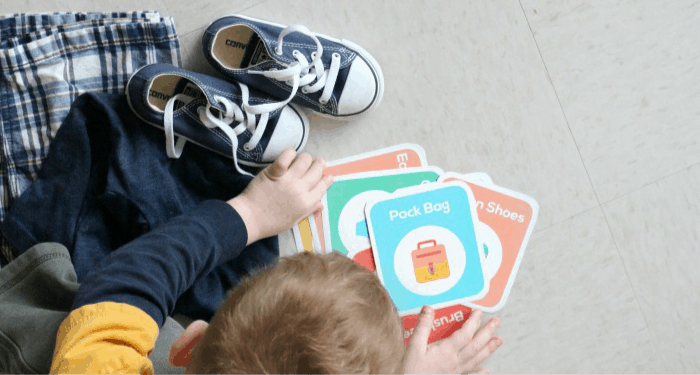
There’s so much of childhood that is new and challenging for kids. Learning self-control and empathy. Learning how to be a friend and interact with others. These are all very BIG things for kids. Using something as simple as these printable routine cards can help kids feel grounded and relaxed. In fact, knowing what to expect at mealtimes, mornings and bedtimes can bring a sense of relief to even the most carefree child.
Have a strong-willed child? Even better. Routines allow kids to feel a sense of control, something that is very important to a strong-willed child

3. Early bedtimes.

Sleep is the building block for healthy brain development. It helps us process the days events and learn from it. Kids brains are constantly developing and creating new neural connections. They absolutely must get sleep to nurture these connections.
Between kid activities, school and always squeezing in tech time, kids are going to bed later and having a difficult time settling before sleep. One of the most basic things you can do for your kids behavior, health and well-being is to help them get the sleep they need. 

4. Empathy.

What do kids really need to be happy and successful? The answer surprises most: Empathy. It’s the trait that allows us to “walk in another person’s shoes.” New research shows that empathy plays a major role in predicting kids’ happiness and success.
Though kids are hardwired to care, they aren’t born empathetic, just like they aren’t born knowing how to order a latte at Starbucks (wink). It’s a learned behavior.  

“Empathy promotes kindness, prosocial behaviors, and moral courage, and it is an effective antidote to bullying, aggression, prejudice and racism. It’s why Forbes urges companies to adopt empathy and perspective-taking principles, the Harvard Business Review named it as one of the ‘essential ingredients for leadership success and excellent performance.’” – Dr. Michele Borba, psychologist and parenting expert.

5. Hugs

There is a saying by Virginia Satir, a respected family therapist, “We need four hugs a day for survival. We need eight hugs a day for maintenance. We need twelve hugs a day for growth.”
“Hugging triggers the release of oxytocin, also known as the love hormone. This feel-good hormone has many important effects on our bodies. One of them is growth stimulation.
Studies show that hugging can instantly boost the level of oxytocin. When oxytocin is increased, several growth hormones, such as insulin-like growth factor-I (IGF-1) and nerve growth factor (NGF), are increased as well. The nurturing touch of a hug can enhance a child’s growth.” – Pamela Li, creator of Parenting for Brain

6. Playful parents

Children don’t say, ‘I had a hard day […] Can we talk?’ They say, ‘Will you play with me?’” – Lawrence Cohen.
We don’t reserve much room in our lives for fun and games anymore. Our days are filled with stress, obligations and hard work, and without realizing it, we are more disconnected from our kids than ever. Play is the work of the child and to connect with our kids, we must play with our kids.
Taking the time to put down our phones and realize that our kids need. us. to. play. It sounds silly, but all the mindless funny cat videos and random Tasty recipes will still be there years later; our children won’t.

7. Outdoor time

“Movement through active free play, especially outside, improves everything from creativity to academic success to emotional stability. Kids who don’t get to do this can have so many issues, from problems with emotional regulation—for example, they cry at the drop of a hat—to trouble holding a pencil, to touching other kids using too much force.” – Meryl Davids Landau, author of Enlightened Parenting

8. Chores

Even though it is more difficult at the time to persist in having children do chores, kids benefit from the experience.
Research indicates that those children who do have a set of chores have higher self-esteem, are more responsible, and are better able to deal with frustration and delay gratification, all of which contribute to greater success in school.
Printable chore cards for kids to teach responsibility, independence and hard work. The perfect alternative to chore charts and behavior reward charts.
Furthermore, research by Marty Rossman shows that involving children in household tasks at an early age can have a positive impact later in life. In fact, says Rossman, ‘the best predictor of young adults’ success in their mid-20’s was that they participated in household tasks when they were three or four.’” Deb Cohen, Center for Parenting Education

9. More screen-time limits

“In order for the brain’s neural networks to develop normally during the critical period, a child needs specific stimuli from the outside environment. These are rules that have evolved over centuries of human evolution, but—not surprisingly—these essential stimuli are not found on today’s tablet screens. When a young child spends too much time in front of a screen and not enough getting required stimuli from the real world, her development becomes stunted.” – Dr. Liraz Margalit, Behind Online Behavior 

10. Experiences, not things.

“Children require less things and far more meaningful experiences. When they grow up, it’s not the stuff in their life they will remember, it’s that time you tried to catch tadpoles at the lake, or that sand castle you both built that the wave knocked over at the beach […] The best life experiences cost little to nothing, like a picnic in the park, blowing bubbles in the backyard, making chalk drawings on the sidewalk, or tossing a football around, but they all have one thing in common: you do them together. What kids really want in life is quality time spent with their parents.” – Sally White, parenting writer

11. Slow moving days.

“I encourage parents to take some time to just watch their children, whether they are playing, doing homework, or eating a snack. Take a moment to drink them in. Remember and remind yourself how remarkable your children are. That pause alone, even if momentary, can drive a shift in the pace.” John Duffy, clinical psychologist

12. Books read to them.


“One of the most important things parents can do, beyond keeping kids healthy and safe, is to read with them. That means starting when they are newborns and not even able to talk, and continuing well beyond the years that they can read by themselves. Study after study shows that early reading with children helps them learn to speak, interact, bond with parents and read early themselves, and reading with kids who already know how to read helps them feel close to caretakers, understand the world around them and be empathetic citizens of the world.” Amy Joyce, parenting writer

13. Music.

“Science has shown that when children learn to play music, their brains begin to hear and process sounds that they couldn’t otherwise hear. This helps them develop ‘neurophysiological distinction’ between certain sounds that can aid in literacy, which can translate into improved academic results for kids.” (source)

Wednesday, March 28, 2018

Help at the Book Store

If you are like me, you love walking into a book store, but once you get there you have no idea what to get for your kiddos or grandkiddos.  Guess what!  There's a study for that!  This study was funded by the National Science Foundation and they determined that books for littles that include individual-level names (names of the characters, places, objects, etc.) promoted language. 

The infants whose parents read the individual-level names spent more time focusing and attending the images, and their brain activity clearly differentiated the individual characters after book reading. 

“There are lots of recommendations about reading books to babies, but our work provides a scientific basis for these recommendations and suggests that the type of book is also important,” she said. "Shared reading is a good way to support development in the first year of life,” “It creates an enjoyable and comforting environment for both the parents and the infant and encourages parents to talk to their infants.”
So the moral of the story is, find books with individual names of the people, objects, places, etc. or when you are "reading" to your kiddo - just talk about the people, objects, places, etc.  Use specific language.  Don't rush.  And start young!

You can read more about the study here: http://news.ufl.edu/articles/2017/12/certain-books-can-increase-infant-learning-during-shared-reading-study-shows.php

Tuesday, March 20, 2018

10 Routines That Will Strengthen a Parent-Child Relationship

This article was written by Laura Markham, Ph.D., the author of Peaceful Parent, Happy Kids: How To Stop Yelling and Start Connecting.  
We all crave those close moments with our children that melt our hearts. Connection is as essential to us as it is to our children. When our relationship is strong, it's also sweet, so we receive as much as we give. That's what makes parenting worth all the sacrifices.
That connection is also the only reason children willingly follow our rules. Kids who feel strongly connected to their parents want to cooperate, if they can. They'll still act like kids, which means their emotions will sometimes overwhelm their still-growing prefrontal cortex. But when they trust us to understand and to be on their side, they're motivated to follow our lead.
Researchers remind us that we need five positive interactions to each negative interaction to keep a relationship healthy. And since we spend so much time guiding — a.k.a. correcting, reminding, scolding, criticizing, nagging, and yelling — it's important to make sure that we spend five times as much time in positive connection.
But we're only human. There are days when all we can do is meet our children's most basic needs. Some days it's nothing short of heroic simply to feed them, bathe them, keep an encouraging tone, and get them to sleep at a reasonable hour — just so we can do it all over again tomorrow.
So given that parenting is the toughest job we have — and that we often do it in our spare time, after being separated all day — the only way to keep a strong bond with our children is to build in daily habits of connection. Here are 10 that don't add time to your day, but do add connection — and could change your life.
1. Aim for 12 hugs (or physical connections) every day.
As family therapist Virginia Satir famously said, "We need 4 hugs a day for survival. We need 8 hugs a day for maintenance. We need 12 hugs a day for growth." 
Snuggle your child first thing in the morning for a few minutes, and last thing at night. Hug when you say goodbye, when you're re-united, and often in between. Tousle hair, pat backs, rub shoulders. Make eye contact and smile, which is a different kind of touch. If your tween or teen rebuffs your advances when she first walks in the door, realize that with older kids you have to ease into the connection. Get her settled with a cool drink, and chat as you give a foot rub. (Seem like going above and beyond? It's a foolproof way to hear what happened in her life today. You'll find yourself glad, many times, if you prioritize that.)
2. Play.
Laughter and rough-housing keep you connected with your child by stimulating endorphins and oxytocin in both of you. Making laughter a daily habit also gives your child a chance to laugh out the anxieties and upsets that otherwise make him feel disconnected — and more likely to act out. And play helps kids want to cooperate. Which is likely to work better?: "Come eat your breakfast now!" or "Little Gorilla, it's time for breakfast — Look, you have bugs and bananas on your oatmeal!"
3. Turn off technology when you interact.
Your child will remember for the rest of her life that she was important enough to her parents that they turned off their phone to listen to her. Even turning off music in the car can be a powerful invitation to connect, because the lack of eye contact in a car takes the pressure off, so kids (and adults) are more likely to open up and share.
4. Connect before transitions. 
Kids have a hard time transitioning from one thing to another. If you look him in the eye, use his name, and connect with him, then get him giggling, you'll make sure he has the inner resources to manage himself through a transition.
5. Make time for one-on-one time.
Do whatever you need to do to schedule 15 minutes with each child, separately, every day. Alternate doing what your child wants and doing what you want during that time. On her days, just pour your love into her and let her direct. On your days resist the urge to structure the time with activities. Instead, try any physical activity or game that gets her laughing. (For game ideas, click here.(link is external))
6. Welcome emotion.
Sure, it's inconvenient. But your child needs to express his emotions or they'll drive his behavior. Besides, this is an opportunity to help your child heal those upsets, which will bring you closer. So summon up your compassion, don't let the anger trigger you, and welcome the tears and fears that always hide behind the anger. Remember that you're the one he trusts enough to cry with, and breathe your way through it. Just acknowledge all those feelings and offer understanding of the pain. Afterward, he'll feel more relaxed, cooperative, and closer to you. (Yes, this is really hard. Regulating our own emotions in the face of a child's upset is one of the hardest parts of parenting. But that doesn't mean we're excused from trying.)
7. Listen, and Empathize.
Connection starts with listening. Bite your tongue if you need to, except to say, "Wow!....I see....Really?...How was that for you?...Tell me more..." 
The habit of seeing things from your child's perspective will ensure that you treat her with respect and look for win/win solutions. It will help you see the reasons for behavior that would otherwise drive you crazy. And it will help you regulate your own emotions so when your buttons get pushed and you find yourself in "fight or flight," your child doesn't look so much like the enemy.
8. Slow down and savor the moment.
You aren't just rushing your child through the schedule so you can spend a few minutes with him before bed. Every interaction all day long is an opportunity to connect. Slow down and share the moment: Let him smell the strawberries before you put them in the smoothie. When you're helping him wash his hands, put yours in the running water with his, and share the cool rush of the water. Smell his hair. Listen to his laughter. Look him in the eyes and meet him heart to open heart, sharing that big love. Connect in the magnificence of the present moment — which is really the only way we can connect. (For most parents, this is also the secret to being able to tolerate playing that same game, yet again.) 
9. Bedtime snuggle and chat. 
Set your child's bedtime a wee bit earlier with the assumption that you'll spend some time visiting and snuggling in the dark. Those companionable, safe moments of connection invite whatever your child is currently grappling with to the surface, whether it's something that happened at school, the way you snapped at her this morning, or her worries about tomorrow's field trip. Do you have to resolve her problem right then? No. Just listen. Acknowledge feelings. Reassure your child that you hear her concern, and that you'll solve it together tomorrow. The next day, be sure to follow up. You'll be amazed how your relationship with your child deepens. And don't give this habit up as your child gets older. Late at night is often the only time teens will open up.
10. Show up.
Most of us go through life half-present. But your child has only about 900 weeks of childhood with you before he leaves your home. He'll be gone before you know it. Try this as a practice: When you're interacting with your child, show up 100 percent. Just be right here, right now, and let everything else go. You won't be able pull this off all the time. But if you make it a habit several times a day, you'll find yourself shifting into presence more and more often, because you'll find it creates those moments with your child that make your heart melt.

Monday, March 12, 2018

The Toy Dilemma

Do you feel like toys are taking over your home?  When the little ones are awake, do you have to clear a path from one room to the next?  Is our parental inclination to buy every toy that will help our kiddos learn actually affecting development in a negative way?

I came across this study that might help alleviate the feeling that if we don't buy the latest developmental toy than we are failing as a parent. 

Toddlers were engaged in two supervised, individual free play sessions.  One play session allowed the children four toys to play with and the other play session allowed sixteen toys to choose from.  The study found that with fewer toys to choose from, there were fewer incidences of toy play, longer duration of toy play, and the children played with toys in a greater variety of ways.  This suggests that when provided with fewer toys in the environment, toddlers engage in longer periods of play with a single toy, allowing better focus to explore and play more creatively.

One of the struggles our little ones are growing up with is learning to focus in an over-stimulating environment.  An environment with fewer toys will lead to higher quality of play for toddlers, the ability to attend longer to a single toy, and an increase in problem solving skills and creative play.

My hypothesis is that combining fewer toy options with caregiver participation in the play will help kiddos learn relationship building and promote creative play at a faster rate.  So put away a box full of toys littering your living room.  You can switch out the toys every few months to generate more interest in the variety of toys you already have.  Then get in there and have fun with your little one.

You can read the article at https://www.sciencedirect.com/science/article/pii/S0163638317301613
Image result for toy play